

Amsterdam Centraal, Amsterdam - Why Does This Train Station Feel Like a Landmark?

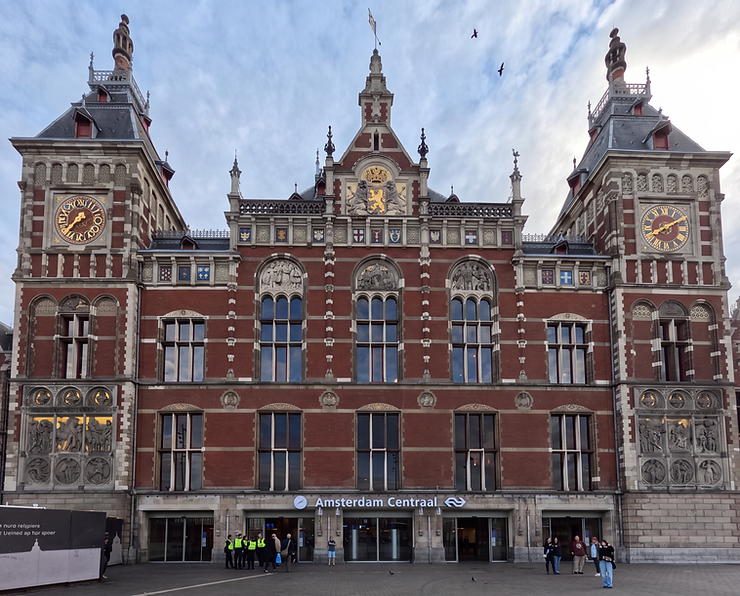
When I arrived in Amsterdam, I expected the city's canals, narrow houses, and bicycles to make the strongest first impression. Instead, the place that made me stop was the train station.
Most transportation hubs are designed with one purpose in mind: keep people moving. Airports guide you from check-in to security. Subway stations point you toward the next platform. They're places we pass through, not places we pause to appreciate.
Amsterdam Centraal felt different.
Before I walked inside, I found myself standing across the plaza looking at the building itself. Its towers rise above the entrance like the front of a civic monument rather than a transportation hub. Decorative stonework, large clocks, and carefully balanced symmetry give the station a presence that seems to announce your arrival before you've even stepped through the doors.
It made me wonder why some train stations feel more like landmarks than transit. Walking to the opposite side of the station answered part of that question.
The architecture changes completely.

The historic brick façade gives way to glass, steel, and wide entrances designed for the movement of thousands of people every day. Cyclists pass continuously in front of the station while ferries, trams, trains, and pedestrians all converge in the same place.
On paper, it sounds like chaos.
In person, it feels surprisingly organized.
Part of that comes from the station itself. The entrances are easy to recognize. The bike lanes have their own rhythm. People seem to know exactly where they're going, even if it's your first morning in the city.
The building manages to serve two purposes at once. One side welcomes visitors with history. The other quietly handles the practical work of moving Amsterdam.

Then there's the water.
A short walk behind the station reveals an entirely different perspective. Ferries cross the IJ, modern buildings stretch across the skyline, and suddenly the city feels far more contemporary than the historic façade first suggested.
If you only photographed the front of Amsterdam Centraal, you might imagine the city as entirely nineteenth-century.
If you only photographed the waterfront, you might think you were looking at a different place altogether.
Standing between those two views, the station becomes more than a transportation hub. It becomes the point where Amsterdam introduces both sides of its identity.
Looking back at these photographs, I don't think Amsterdam Centraal feels memorable simply because it's beautiful.
It feels memorable because it does something most transit buildings don't.
It creates a sense of arrival.
Before you've wandered a canal, visited a museum, or found your hotel, the station quietly tells you that you've reached somewhere with its own history, rhythm, and character.
That's what makes it feel less like a place to pass through and more like the first landmark of the journey.
What do you notice?
Have you visited a train station that felt more like a landmark than a place to catch a train?


Comments